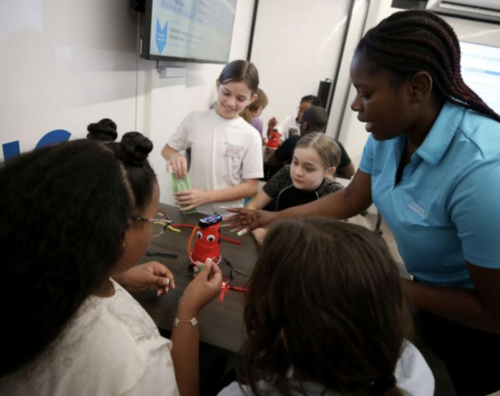
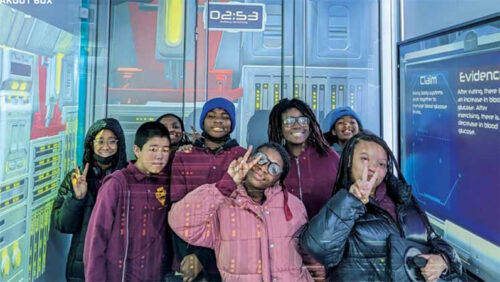
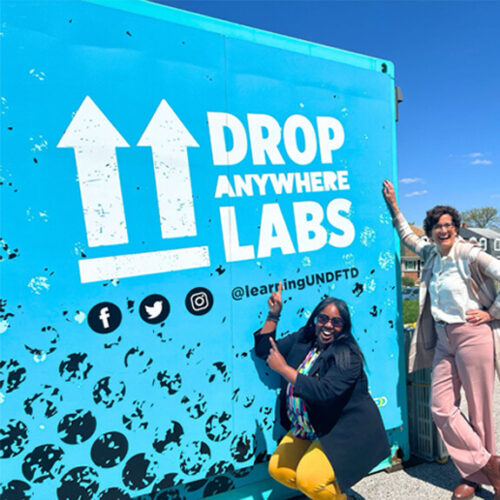
A metal shipping container in the parking lot of Levi Fry Intermediate, part of Texas City ISD, pulsed with laughter and whirring motors Tuesday as students raced to bring tiny robots to life inside a traveling science lab.
Inside, fifth graders tested circuits, debated designs and cheered as their “wigglebots” jittered and spun — small victories in a hands-on STEM experience educators said could shape how students see their future.
Learning Undefeated, an education nonprofit focused on science, technology, engineering and math education, partnered with the Texas Education Agency to provide mobile labs for K-8 students at no cost to school districts.
“It’s an amazing experience,” science teacher Deeanna Salenger said. “I’m glad my students had this opportunity.”
INSIDE THE LAB
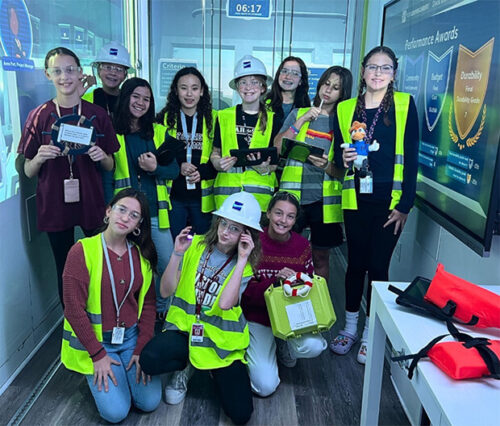
Over four days, about 375 students took part in activities focused on science and engineering concepts, including electronic circuits, flood barrier design, biomimicry and ecological balance.
The lab itself is a 560-square-foot expandable pod — about the size of a studio apartment — equipped with hands-on materials and staffed by traveling educators who guide students through engineering design challenges aligned with Texas Essential Knowledge and Skills standards.
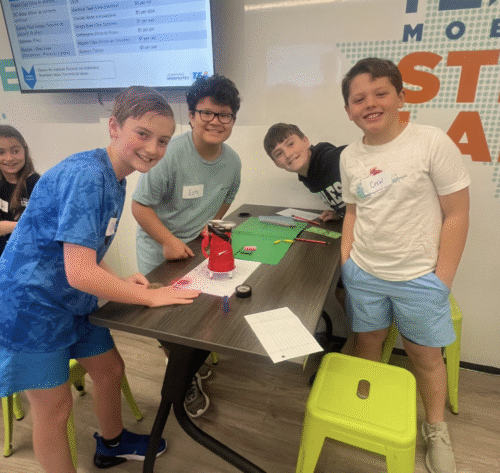
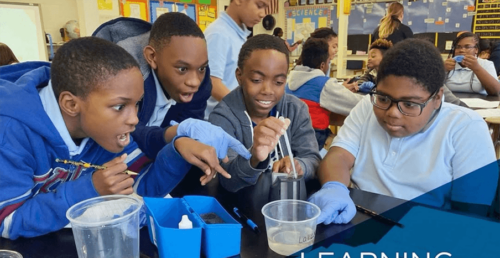
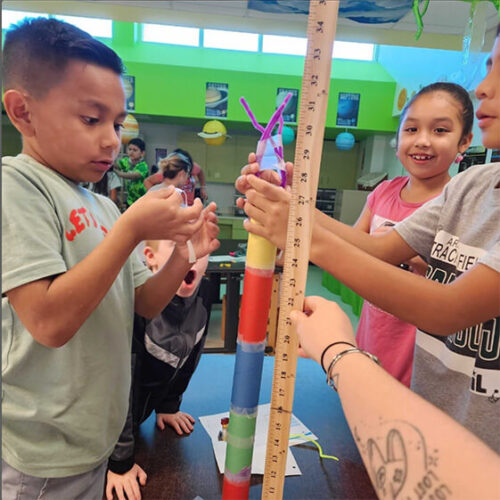
Salenger’s classes, nearly 100 students total, learned about circuits and motors, then took on an engineering challenge in which groups built a decorated plastic cup, called a wigglebot, designed to dance, spin a clothespin and light an LED.
Working within a budget, students had to decide which accessories to add, how to wire their motors to create movement and whether to attempt a bonus challenge to make their robots draw with markers.
“It’s fun,” fifth-grade student Donald Columbus said.
Working with two other boys, he tried placing the motor in different parts of the cup and connecting alligator clips to power the LED. After some trial and error, they got the wigglebot to groove.
Each activity inside the lab follows an engineering framework — defining a problem, identifying constraints, building and testing solutions and refining designs — giving students a hands-on look at real-world problem-solving.
The task was somewhat challenging, but Columbus argues he can see himself as a scientist or engineer one day, he said.
BEYOND THE CLASSROOM
For many students, the lesson doesn’t stop there.
Research shows early exposure to STEM education can carry lasting benefits for students.
Research indexed in the National Library of Medicine shows students in STEM programs outperform peers in creative thinking after just a few weeks of instruction.
And the benefits extend beyond academics: a study of kindergarten students found engineering design challenges significantly improved communication and cooperation skills.
The United States will need up to 1.4 million more workers in science, technology, engineering and math fields by 2030, according to analyses from the National Math and Science Initiative and the National Science Board.
STEM jobs are growing faster than most occupations, with demand projected to outpace the supply of qualified workers.
That need has led policymakers and educators to focus on building interest and skills earlier, including through hands-on STEM learning in childhood.
The Texas Education Agency awarded Learning Undefeated a $2.9 million grant in 2024 to expand its mobile STEM lab program for the 2025-26 school year, part of a broader investment totaling about $7 million to build and operate labs statewide.
BACK IN THE LAB
The program operates a fleet of nine mobile labs that serve all 20 Texas education regions, reaching about 270 schools and more than 75,000 students each year, with each lab serving about two dozen students at a time.
More than 1,000 educators applied for a visit during a recent application cycle, reflecting strong demand for the program statewide.
Levi Fry was the first school in Galveston County to host the STEM lab this year, selected through a competitive application process open to schools statewide, although the program is expected to expand to other Texas City ISD and Clear Creek ISD schools.
Organization officials urged parents interested in bringing the program to their schools to work with teachers and administrators to apply through the organization’s teacher priority network on its website, where campuses can express interest, help guide where labs are deployed and receive updates on potential visits.
Applications typically open in April for the following school year.
Back in the lab, educators say its impact is measured in the moments when students discover what they can build and understand.
“I love this job,” Megan McKie, education outreach coordinator with the organization, said. “It’s so nice to see them learning something new.”
Game On: Reimagining Career Exploration Through Play
Mar 12, 2026
Breakout Box, Manufacture Your Path, News, Partners, stem
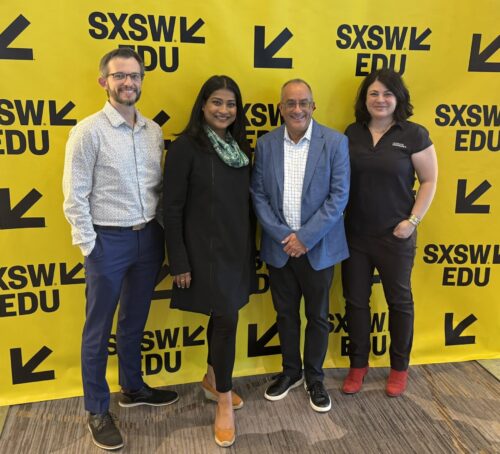
Live from SXSW EDU, leaders from Learning Undefeated, Caterpillar Foundation, and K–12 education came together to explore how game‑based learning can transform career exploration—especially in manufacturing and other high‑demand STEM fields. These experiences align with science and engineering practices while building durable skills like critical thinking, communication, and adaptability.
Texas Mobile STEM Lab Brings Hands-on Learning to Lindale ISD
Feb 12, 2026
News, Texas, Texas Mobile STEM Lab
By: Chloe Collins, KETK Fifth grade students at E.J. Moss Intermediate stepped inside a high-tech classroom on wheels this week as the Texas Mobile STEM Lab rolled onto campus for…
Ride On Bus System Opens Doors to Science, Technology Opportunities for Students
Feb 11, 2026
By: The Montgomery County Department of Transportation The Montgomery County Department of Transportation’s (MCDOT) Ride On buses are helping a local nonprofit expand opportunities for underrepresented students by providing reliable…