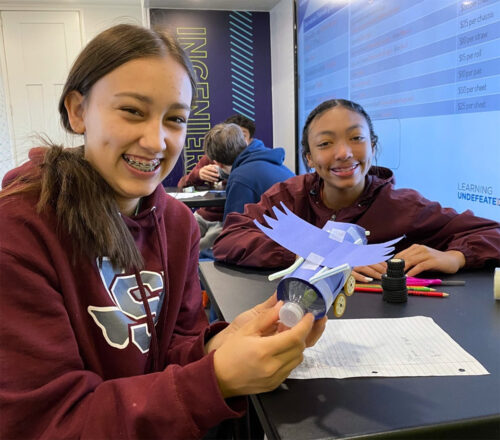
In this design challenge, students will design a truck that is as efficient as possible for Jennifer’s transportation company. Students will learn about Newton’s Laws of Motion, with emphasis on the first and third law, and see a laboratory demonstration of a chemical reaction. The chemical reaction will occur between acetic acid and sodium bicarbonate, the same materials they will use for their design challenge.
The students will be presented with the following problem:
“Jennifer’s transportation company is currently trying to figure out how to maximize the output of her trucks. They travel far distances with a lot of goods and do not want to waste any fuel.”
The students will put on their engineering hats to build a truck that will travel an exact distance on a single tank of gas. Students will engage in a STEM challenge to design a truck powered by a chemical reaction that will have to stop within a specific drop-off zone. Teams will be challenged with various payloads to earn bonus points if they can stop in the drop-off zone!
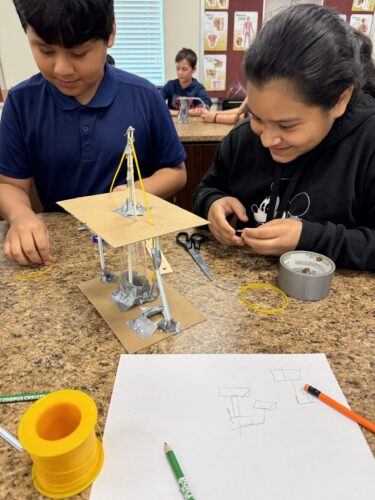
In this design challenge, students will act as engineers to build and test cranes that can lift and move payloads at a port. By applying Newton's Three Laws of Motion, students will explore how balance, force, and motion work together to create stable and efficient cranes.
Students will analyze the effect of forces on a brain model, gather collision data from tested materials, and go through the engineering process to design a new helmet.