Skip to Content

RADAR

Explore wave properties through the lens of radars.

Radar scan
triangles

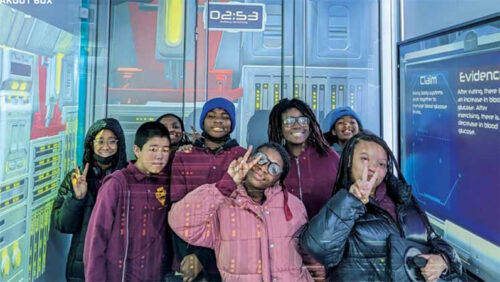
RADAR is an activity developed by Learning Undefeated to help students explore wave properties through the lens of radars.

In this activity, students are introduced to radar and the Doppler effect as well as how it applies to plane detection and air traffic control.  Students will use a constructed radar box to model the data collected by radar systems.  Students will use the provided equipment to identify the object of a shape they cannot see by using the equipment to measure the distance to the object from a sensor.  Students will also collect simulated data of an object in motion to see how the same equipment can relay information of not only distance but movement and direction as well. Students will see how this applies to the Department of Defense and understand the need for updated radar systems to detect fast-moving and low-flying vehicles.

Learning Objectives

  • Standards Alignments + Connections

  • Activity Components

  • Additional Resources

    Why Hypersonic Missiles’ Greatest Strength Also Makes Them Vulnerable

    Unique phenomena at hypersonic speeds could also make those weapons easier to detect and track for certain sensors.

    Hypersonic Weapons Demand Longer Range Radars and Space- Based Sensors for Detection

    A blisteringly fast threat that requires longer-range radars and space-based sensors looms on the horizon in the form of hypersonic vehicles and missiles.


    Keep Going! Your Students May Also Enjoy...

    Wave Machine
    ali main teaches waves

    Wave Machine

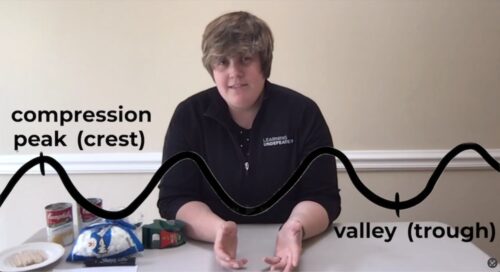
    Explore transmission, absorption, and reflection of waves! Build a wave machine to investigate how different materials (mediums) react to a wave to create these wave behaviors!


    Grade Level: Middle School (6 - 8)

    Subject: Physical Science , Physics

    Curriculum Unit: Waves and their Applications

    Rescue and Design
    cat without legs

    Rescue and Design

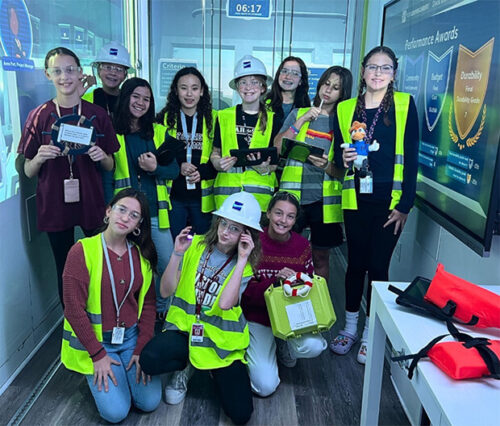
    In this design challenge, students take on the role of biomedical engineers to design a prosthetic that helps an injured marine animal regain its ability to swim.

    Grade Level: Middle School (6 - 8)

    Subject: Biology and Life Sciences , Engineering

    Curriculum Unit: Engineering Design

    Forces In Action
    student in lab

    Forces In Action

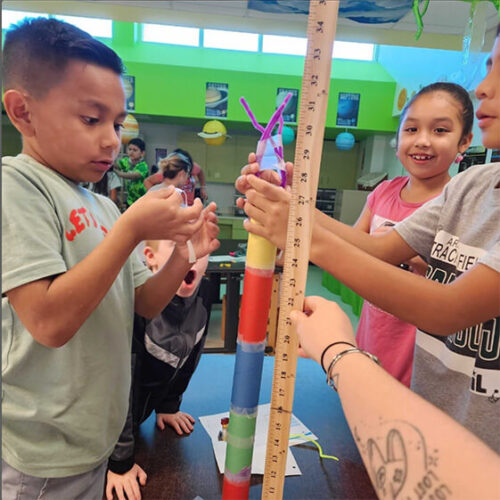
    In this design challenge, students will act as engineers to build and test cranes that can lift and move payloads at a port. By applying Newton's Three Laws of Motion, students will explore how balance, force, and motion work together to create stable and efficient cranes.

    Grade Level: Middle School (6 - 8)

    Subject: Engineering , Physics

    Curriculum Unit: Energy , Engineering Design , Forces and Interactions

    How Did It Go? Send Us Feedback (or Pics)!

    Join the Mission