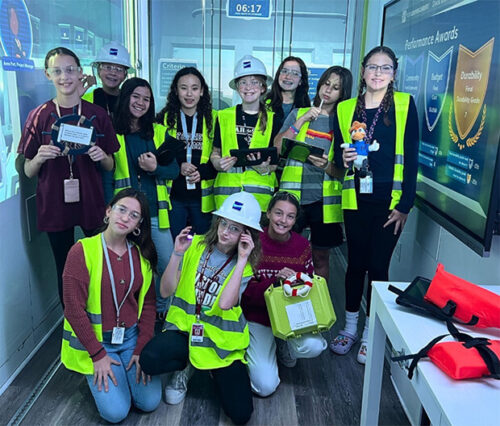
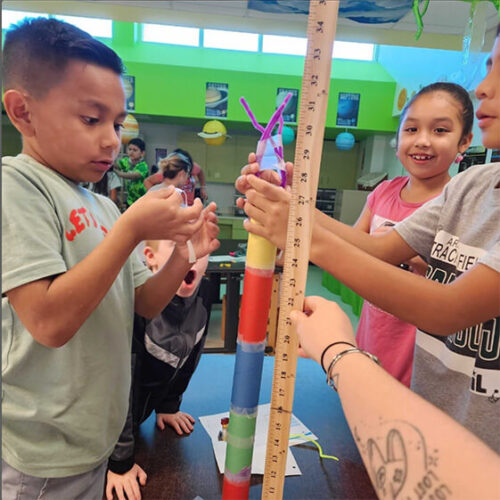
The Spark of Life is a hands-on activity that introduces students to the electrical and mechanical systems that keep the heart beating. Students explore how the heart maintains a steady rhythm and discover how pacemakers can help when that system is disrupted. They then work together to respond to challenges that affect the heart’s ability to function.
Learning Objectives
Demonstrate how system disruptions like slow heart rates affect the body.
Compare the roles of natural biological systems versus engineered medical interventions.
Standards Alignments + Connections
SC.MS.1.5: Construct, use, and present arguments to support the claim that when the kinetic energy of an object changes, energy is transferred to or from the object.
SC.MS.2.1: Use argument supported by evidence for how the body is a system of interacting subsystems composed of groups of cells.
6.MS-ETS1-1:Define the criteria and constraints of a design problem with sufficient precision to ensure a successful solution. Include potential impacts on people and the natural environment that may limit possible solutions.
6.MS-LS1-3: Construct an argument supported by evidence that the body systems interact to carry out essential functions of life.
7.MS-PS3-5: Present evidence to support the claim that when the kinetic energy of an object changes, energy is transferred to or from the object.
7L.4.1.1.1: Support or refute an explanation by arguing from evidence for how the body is a system of interacting subsystems composed of groups of cells.
8P.4.1.1.2: Compare and evaluate evidence to support the claim that when the kinetic energy of an object changes, energy is transferred to or from the object.
ETS1: Define the criteria and constraints of a design problem with sufficient precision to ensure a successful solution, taking into account relevant scientific principles and potential impacts on people and the natural environment that may limit possible solutions.
MS-LS1-3: Use argument supported by evidence for how the body is a system of interacting subsystems composed of groups of cells.
MS-PS3-5: Apply scientific principles to design, construct, and test a device that either minimizes or maximizes thermal energy transfer.
MS-ETS1-1: Define the criteria and constraints of a design problem with sufficient precision to ensure a successful solution, taking into account relevant scientific principles and potential impacts on people and the natural environment that may limit possible solutions.
Activity Components
The Spark of Life begins by introducing students to the heart as a coordinated system of electrical signals and mechanical movement. Students examine how electrical signals travel through the heart and how the chambers work together to pump blood throughout the body. This foundation gives students a framework for understanding how disruptions to the heart’s electrical system can affect its function.
Students then put that knowledge into practice through “Steady the Beat,” a team-based activity in which they role-play the heart, pacemaker, and patient. Across three rounds, teams work to maintain homeostasis while responding to changes in the heart’s rhythm, including disruptions such as sinus node disorder. The experience challenges students to communicate, adapt, and work together to keep the system functioning.
This activity provides the key vocabulary and basic science understanding of pacemakers to support their experience in the Medtronic Spark Explore Mobile Experience.