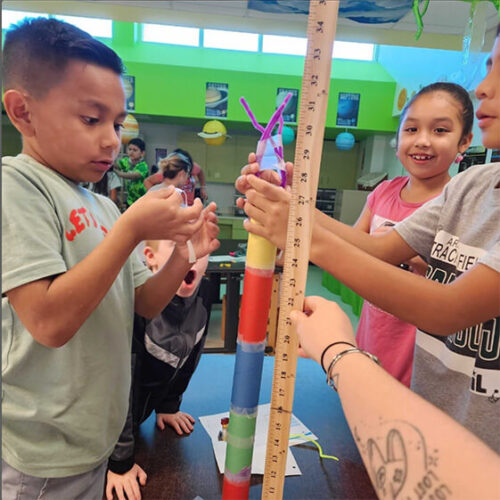
In this design challenge, students will receive a problem inspired by the story Finding My Dance by Ria Thundercloud. In the story, Ria describes her journey of self-discovery through different forms of dance. The students will be presented with the following problem: “Ria got invited to perform a new dance at an upcoming festival. She is looking for some musicians who can create unique instruments for her dance that can play loud enough for her to hear them on a stage that is 6 meters away. Today, you are going to put on your engineering hat to build some instruments for Ria’s dance performance.” Students will engage in a STEM challenge to build instruments in 25 minutes, create a rhythm to communicate choreography to Ria while she dances, and ensure the instrument can be heard on a stage 6 meters away.
Learning Objectives
Build a strong structure by understanding the physical properties of objects
Classify building materials by their physical properties
Classify objects by the materials from which they are made
Demonstrate that objects can be changed by cutting and folding
Combine materials to make a strong structure
Count forward and backward to at least 20 with and without objects
Use measuring tools to measure the length of objects
Demonstrate understanding of halves, fourths, and eights
Solve a problem using the engineering design process
Standards Alignments + Connections
1-PS4-4: Use tools and materials to design and build a device that uses light or sound to solve the problem of communicating over a distance.
K-2-ETS1-2: Develop a simple sketch, drawing, or physical model to illustrate how the shape of an object helps it function as needed to solve a given problem.
K-2-ETS1-3: Analyze data from tests of two objects designed to solve the same problem to compare the strengths and weaknesses of how each performs.
Standards for Mathematics
K.CC.A.1: Count to 100 by ones and tens
K.CC.B.4: Understand the relationship between numbers and quantities; connect counting to cardinality.
K.CC.B.5: Count to answer “how many?” questions about as many as 20 things arranged in a line, a rectangular array, or a circle, or as many as 10 things in a scattered configuration; given a number from 1-20, count out that many objects.
K.OA.A.2: Solve addition and subtraction word problems, and add and subtract within 10, e.g., by using objects or drawings to represent the problem
K.MD.A.2: Directly compare two objects with a measurable attribute in common, to see which object has “more of”/”less of” the attribute, and describe the difference.
K.G.B.5: Model shapes in the world by building shapes from components (e.g., sticks and clay balls) and drawing shapes.
1.OA.C.5: Relate counting to addition and subtraction.
1.OA.C.6: Add and subtract within 20, demonstrating fluency for addition and subtraction within 10.
2.OA.B.2: Fluently add and subtract within 20 using mental strategies.
2.MD.A.1: Measure the length of an object by selecting and using appropriate tools such as rulers, yardsticks, meter sticks, and measuring tapes.
Standards for English Language Arts
RL.K.1 With prompting and support, ask and answer questions about key details in a text.
RL.K.10 Actively engage in group reading activities with purpose and understanding.
SL.K.1 Participate in collaborative conversations with diverse partners about kindergarten topics and texts with peers and adults in small and larger groups.
RL.1.1: Ask and answer questions about key details in a text.
SL.1.1: Participate in collaborative conversations with diverse partners about grade 1 topics and texts with peers and adults in small and larger groups.
RL.2.1: Ask and answer such questions as who, what, where, when, why, and how to demonstrate understanding of key details in a text.
SL.2.1: Participate in collaborative conversations with diverse partners about grade 2 topics and texts with peers and adults in small and larger groups.
2021 Science TEKS covered in this design challenge
Students will engage in a STEM challenge to design a truck powered by a chemical reaction that will have to stop within a specific drop-off zone. Teams will be challenged with various payloads to earn bonus points if they can stop in the drop-off zone.
Students will engage in a STEM challenge to design a catapult that can land on two different targets. In this design challenge, students will explore forces and motion in the operation of the simple machine known as a lever