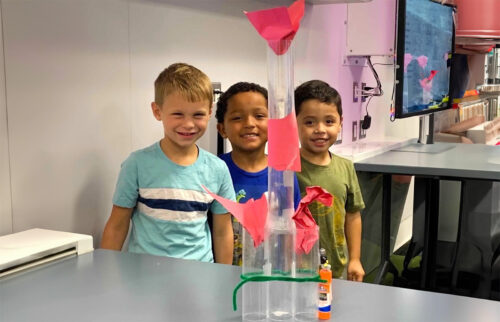
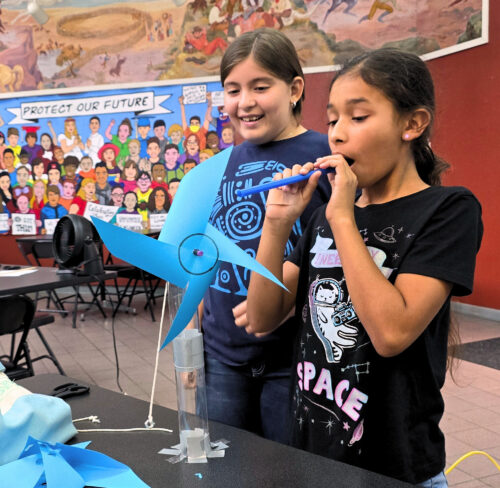
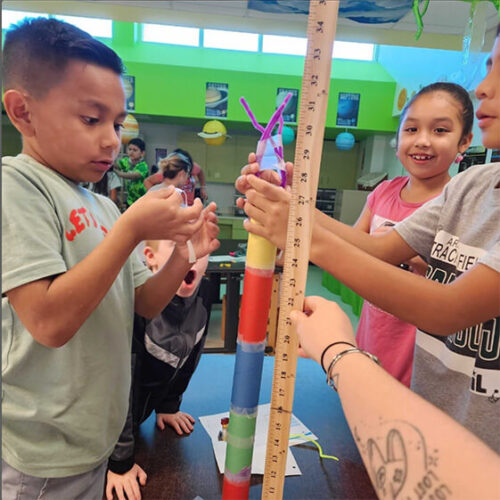
In this design challenge, students will receive a problem inspired by the story Jack and the Beanstalk by Carol Ottolenghi. In the story, Jack climbs a magical beanstalk where he finds a castle that he steals several items from before returning home. The students will be presented with the following problem: “Jack wants to go back to the castle in the sky to return the hen and the harp he stole, but he is out of magic beans. He does not know how he will get back to the castle. Today, you are going to put on your engineering hat to help Jack build a “beanstalk” that can reach all the way to the giant’s castle in the sky so he can return the stolen items.” Students will engage in a STEM challenge to build the tallest structure in 25 minutes that can hold a toy figure (Jack) for one minute. Teams will receive bonus points if their structure can withstand a 30-second windstorm before Jack safely returns to his home on the ground.
Learning Objectives
Build a strong structure by understanding the physical properties of objects
Classify building materials by their physical properties
Classify objects by the materials from which they are made
Demonstrate that objects can be changed by cutting and folding
Standards Alignment + Connections
2-PS-1: Plan and conduct an investigation to describe and classify different kinds of materials by their observable properties.
2-PS-2: Analyze data obtained from testing different materials to determine which materials have the properties that are best suited for an intended purpose
K-2-ETS1-2: Develop a simple sketch, drawing, or physical model to illustrate how the shape of an object helps it function as needed to solve a given problem.
K-2-ETS1-3: Analyze data from tests of two objects designed to solve the same problem to compare the strengths and weaknesses of how each performs.
Standards for Mathematics
K.CC.A.1: Count to 100 by ones and tens
K.CC.B.5: Count to answer “how many?” questions about as many as 20 things arranged in a line, a rectangular array, or a circle, or as many as 10 things in a scattered configuration; given a number from 1-20, count out that many objects.
K.OA.A.2: Solve addition and subtraction word problems, and add and subtract within 10, e.g., by using objects or drawings to represent the problem.
K.G.B.5: Model shapes in the world by building shapes from components (e.g., sticks and clay balls) and drawing shapes.
1.OA.C.5: Relate counting to addition and subtraction.
1.OA.C.6: Add and subtract within 20, demonstrating fluency for addition and subtraction within 10.
2.OA.B.2: Fluently add and subtract within 20 using mental strategies.
2.MD.A.1: Measure the length of an object by selecting and using appropriate tools such as rulers, yardsticks, meter sticks, and measuring tapes.
Standards for English and Language Arts
RL.K.10 Actively engage in group reading activities with purpose and understanding.
SL.K.1 Participate in collaborative conversations with diverse partners about kindergarten topics and texts with peers and adults in small and larger groups.
RL.1.1: Ask and answer questions about key details in a text.
SL.1.1: Participate in collaborative conversations with diverse partners about grade 1 topics and texts with peers and adults in small and larger groups.
RL.2.1: Ask and answer such questions as who, what, where, when, why, and how to demonstrate understanding of key details in a text.
SL.2.1: Participate in collaborative conversations with diverse partners about grade 2 topics and texts with peers and adults in small and larger groups.
2021 Science TEKS covered in this design challenge
Students will engage in a STEM challenge to design a truck powered by a chemical reaction that will have to stop within a specific drop-off zone. Teams will be challenged with various payloads to earn bonus points if they can stop in the drop-off zone.