


Designing Solutions to Concussions (Classroom)
Designing solutions to prevent traumatic brain injuries
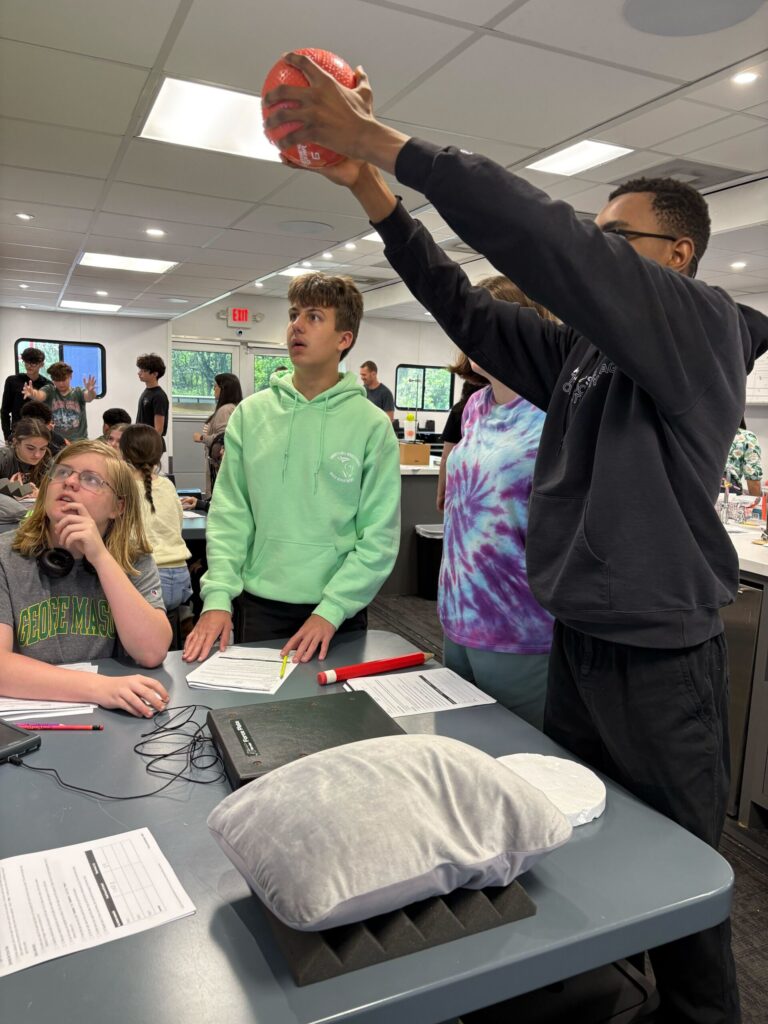
This unit will introduce students to the issue of concussions. Students will try to resolve this problem by ultimately designing a new helmet. Activities throughout will explain the physics of collisions and how materials can reduce concussion events.
Looking for the mobile laboratory version of It’s All in Your Head? Click here.
Looking for the answer keys for this activity bundle? Complete this form to gain the password to our Activity Keys webpage.
Learning Objectives
Students will know
- Newton’s three laws of motion
- The relationship between force, time, mass, and change in velocity
Students will understand
- How the application of force to the head can cause trauma
- How helmet materials reduce the chances of concussions.
Students will be able to
- Complete the engineering design process to protect an egg from a fall
- Analyze data (including force, velocity, acceleration, and time) to determine the most protective material for a collision.
- Analyze data by creating tables and graphs.
Standards Alignments + Connections
Next Generation Science Standards Connections
MS-PS2-1: Apply Newton’s Third Law to design a solution to a problem involving the motion of two colliding objects.
Texas Essential Knowledge and Skills Connections
8.6C: investigate and describe applications of Newton’s three laws of motion such as in vehicle restraints, sports activities, amusement park rides, Earth’s tectonic activities, and rocket launches
Unit Plan
Determining the Problem
Students will watch the introductory video “What happens when you have a concussion?” by TED-Ed. Students will then identify the problem at hand and will brainstorm solutions to this problem.
Solutions may include:
- Better helmets
- Changing sport rules
- Adding sensors to helmets to detect concussions
Activities to Gather Evidence
Bouncing Balls
Understanding Momentum
Students will drop three different balls on a surface and measure the bounce height. This will introduce the relationship between mass and momentum to the students.
Egg Drop Challenge
Learning About Protective Materials
Students will design a protective barrier for an egg, so that the egg can survive a drop from 4, 6, and 8 ft. This will introduce students to the protective materials.
Egg Drop Simulation
How Materials are Protective
Students use a simulation to collect data regarding the egg’s change in velocity, the time of the collision, and the force experienced. The main takeaway from this is that the force can be lowered by increasing the time of the collision. This force experienced by the egg is the same force felt by the floor surface.
Football in the Lab
NFL Data
Students discuss data collected by reconstructed NFL collisions that resulted in concussions. Students will graph data to learn how acceleration and impact force are related. Students will also compare collisions that resulted in concussions and collisions that did not in the form of a bar graph.
Designing a Safer Helmet
Designing Solutions
Students pick a material to use in a new helmet design. Students then analyze the provided data to compare their material to no protection and see how the values of force and time of collision differ.
Conclusion Assessment
Students design a poster advertisement for their newly designed helmet, complete with slogans, pictures, and data.
Keep Going! Your Students May Also Enjoy...

The Next Generation of Innovators

Medtronic Spark Explore Mobile Experience