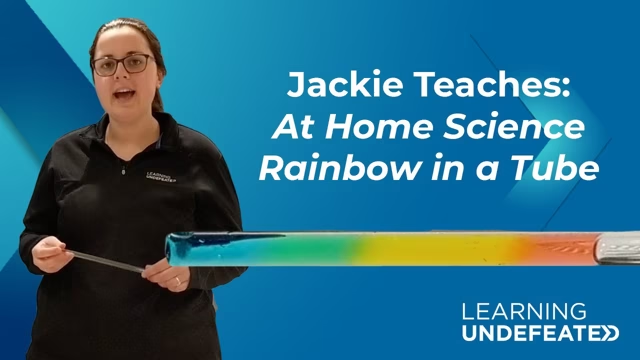
Rainbow in a Tube
What is the difference between the two images below?

They look identical, right? There is a small difference that you were not able to catch by observing these two images. The cup on the right (cup B) has 6 tablespoons of sugar in it. Although we cannot recognize this with our eyes, we can do an experiment to prove this claim. But first we need to talk about matter!
Matter is any substance that has mass and takes up space by having volume. Look around the room it is full of matter. However, all matter does not look the same. Matter exists in the form of solids, liquids, gases, and plasmas. Sometimes matter cannot be seen or felt, like the air we breathe.
Matter has properties and those are referred to as the traits we can measure . One of the properties of matter is density. Density is how many particles are packed into a material. Think about the water in the images above. Because they have the same volume, they most likely have the same number of water molecules. But for the cup on the right the sugar was added and dissolved even though you may not see it with the naked eye. The sugar occupies the space in between the water molecules and increases the density of the solution.
Learning Objectives
Students will know
- Matter
- Density
Students will understand
- Matter is made of particles too small to be seen.
- The more matter in a sample, the denser it is.
Students will be able to
- Create solutions of different densities and see them layered in a clear straw/tube.
- Use a model to describe the particles in each of the solutions
Standards Alginment + Connections
Next Generation Science Standards Connections
5-PS1-1: Develop a model to describe that matter is made of particles too small to be seen.
Texas Essential Knowledge and Skills Connections
5.5A: Classify matter based on measurable, testable, and observable physical properties, including mass, magnetism, physical state (solid, liquid, and gas), relative density (sinking and floating using water as a reference point), solubility in water, and the ability to conduct or insulate thermal energy or electric energy.
How to Run the Experiment
Materials You Will Need
- 4 cups of the same size
- Warm water
- 1.25 cups sugar
- Tablespoon measure
- Clear straw or tube
- Red, yellow, blue, and green food coloring
- Spoon or stirring utensil
Running the Experiment
Download the handouts and watch the video above.
Keep Going! Your Students May Also Enjoy...
The Next Generation of Innovators
Medtronic Spark Explore Mobile Experience