
Moon’s Disappearing Act
Understanding Our Moon's Place in the Solar System
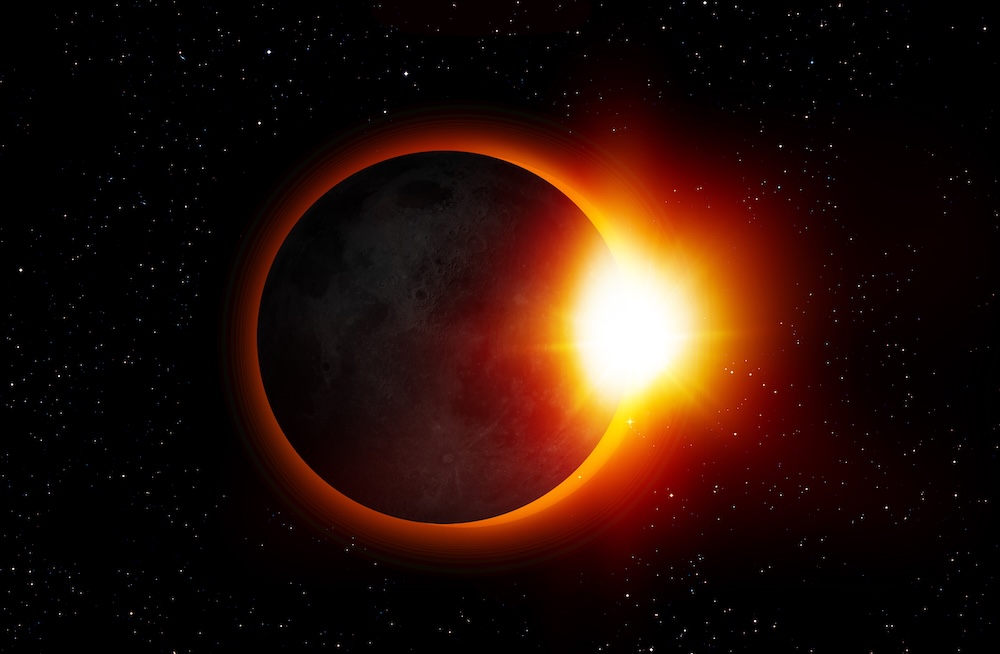
This unit will introduce students to solar eclipses. Students will develop questions after being introduced to phenomena. Throughout the unit, students will analyze pieces of evidence to answer their questions and eventually come to understand the sun, earth, moon system.
Looking for the answer keys for this activity bundle? Complete this form to gain the password to our Activity Keys webpage.
Learning Objectives
Students will know
- Lunar cycle
- Lunar orbital tilt
- Solar eclipses
- Earth’s axial tilt
- Sun-Moon-Earth System
Students will understand
- Why the view of the moon changes night to night
- How solar eclipses occur
- Why solar eclipses occur don’t occur in the same location every eclipse season
Students will be able to
- Use lunar journals to see the pattern of the moon’s visible shape over time
- Use a model of the Earth-sun-moon system to understand the lunar cycle
- Use physical and computer models to understand changes in moon peak times
- Use a model to understand solar eclipses only occur during new moon phases and only when the moon’s orbit passes in front of the sun
- Collect and analyze data about solar eclipses from 2010-2020
- Draw conclusions about the cause of the phenomena and the reason those locations were able to see it
Standards Alignments + Connections
Next Generation Science Standards Connections
MS-ESS1-1 Earth’s Place in the Universe: Develop and use a model of the Earth-sun-moon system to describe the cyclic patterns of lunar phases, eclipses of the sun and moon, and seasons.
Texas Essential Knowledge and Skills Connections
8.7(B): demonstrate and predict the sequence of events in the lunar cycle
Unit Plan
Introductory Phenomenon
Students are introduced to the phenomena: two days where the moon disappeared from view in the night sky the same day that the sun was briefly blocked causing darkness at noontime. The phenomena have GIFs of the solar incident in addition to the moon imagery preceding and following the solar event.
Students can view the phenomena via slide presentation and can gather their thoughts and questions on the What’s Going On? document.
Questions may include:
- Why was the moon not visible the night of the solar incident?
- Why did the moon look like it was disappearing and then come back?
- Did something go in front of the sun, blocking it?
- Does this type of solar event happen often?
- Are the solar and lunar events linked?
Activities to Gather Evidence
Why did the moon disappear and come back?
Investigating Moon Phases
Students use collected moon data to analyze two months of moon images. Students analyze the images to recognize patterns. Alternatively, students could complete the moon journal on their own in real-time.
Students use an Earth-sun-moon model to visualize and understand why we see a cyclical lunar pattern. Students are also introduced to moon phase names in a provided video.
Students can refer to this video (until 3:08) for help setting up and using their model.
Students use their Earth-sun-moon model to make predictions about why the moon is visible at different times of the day and night. Students then use a computer model to collect data and test their hypotheses.
Students can refer to this video (3:08-6:03) for help setting up and using their model.
What caused the weird event in the middle of the day?
Investigating Solar Eclipses
Students use their Earth-sun-moon model to show a solar eclipse and watch videos to learn more about the information scientists gather from these events.
- Introduction to Solar Eclipses
- Students can refer to this video (6:03-7:15) for help setting up and using their model.
Students modify their Earth-sun-moon model to account for the moon’s orbital angle in addition to the earth’s revolution around the sun to understand the frequency of solar eclipses.
- A Solar Eclipse Every Month?
- Students can refer to this video (7:15-end) for help setting up and using their model.
Why were these similar events viewed in different places at different times?
Understanding Eclipse Season Locations
Students use NASA solar eclipse data to see where previous eclipses have been visible to see the pattern of eclipses in the northern and southern hemispheres.
Students will use a 3D solar compass to see the sun’s path in different locations to learn that the Earth’s axis is tilted.
Conclusion Assessment
Students construct a claim backed up by evidence and reasoning to answer the following question:
Why did the sun disappear briefly from Chile’s sky in February 2017 and from Idaho’s sky in August 2017?
The sun, Earth, moon model used in this bundle is adapted from National Science Teacher Association: Moon Phases Demonstration for use by Learning Undefeated.
Keep Going! Your Students May Also Enjoy...

The Next Generation of Innovators

Medtronic Spark Explore Mobile Experience